
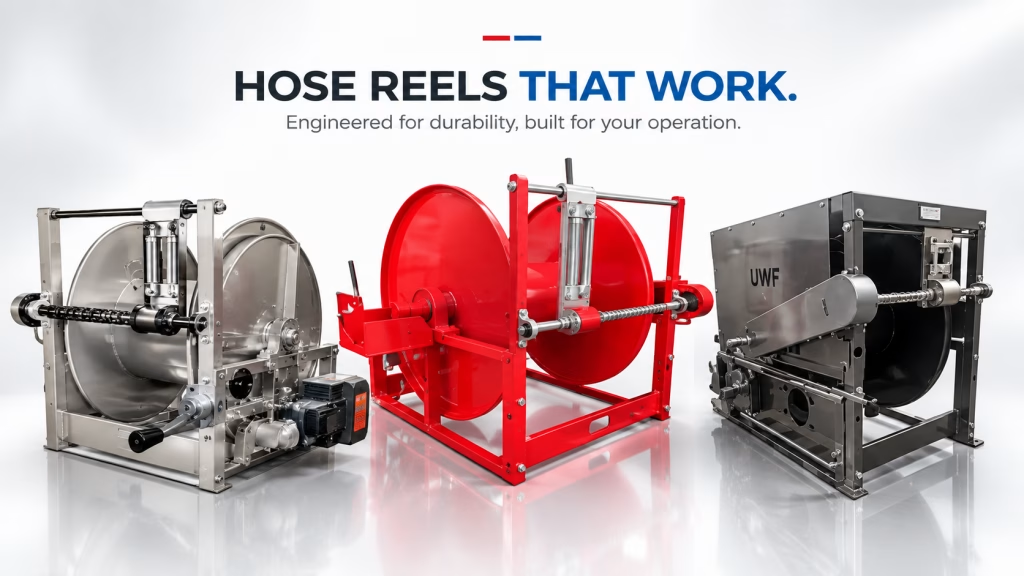
Not all hose reels are built for the same job.
A hose reel used for aviation fueling has different demands than one used for industrial cleaning, firefighting, or petroleum delivery. From the rewind mechanism to the reel construction and fluid path, every design decision affects how the equipment performs.
Industrial hose reels are specialized equipment designed to store, deploy, and retrieve hoses used in demanding commercial and industrial applications. They are available in manual, spring rewind, electric, hydraulic, and air-operated configurations, with designs tailored to different hose sizes, pressures, fluids, and environments.
Understanding these differences is the first step toward selecting equipment that works for your operation.
At Unique Hose Reels (UHR), we specialize in custom-manufactured industrial hose reels designed around the requirements of the application.
What Are the Different Types of Industrial Hose Reels?
Industrial hose reels are commonly categorized by their rewind mechanism, construction, and intended application.
The five primary rewind types are:
- Hand Crank Hose Reels: Manually operated for controlled hose retrieval.
- Spring Rewind Hose Reels: Automatically retract hose using stored spring energy.
- Electric Hose Reels: Use an electric motor for powered hose retrieval.
- Hydraulic Hose Reels: Use hydraulic power for demanding industrial applications.
- Air-Operated Hose Reels: Use compressed air to power the rewind mechanism.
Each design offers distinct advantages depending on the operating conditions.
1. Hand Crank Hose Reels: Simple, Dependable Operation
Hand crank hose reels use a manually operated crank to wind the hose onto the drum.
Their straightforward design makes them a practical solution for applications where powered rewind is unnecessary or where electrical, hydraulic, or compressed-air power is unavailable.
Common applications:
- Industrial maintenance
- Water transfer
- Service vehicles
- Fuel handling
- General industrial operations
Key advantages:
- No external power source required
- Straightforward mechanical operation
- Operator-controlled hose retrieval
- Suitable for mobile and stationary installations
- Custom configurations available
Hand crank reels are an effective option when simplicity and operator control are priorities.
However, larger or heavier hoses can require considerable manual effort, making powered rewind a better choice for some applications.
2. Spring Rewind Hose Reels: Convenient Automatic Retrieval
Spring rewind hose reels use stored mechanical energy to retract the hose.
As the hose is extended, the spring mechanism stores energy that is released during retrieval.
This eliminates the need to manually crank the hose onto the reel.
Common applications:
- Industrial maintenance
- Water and air service
- Fuel and petroleum handling
- Service equipment
- Applications requiring frequent hose deployment
Key advantages:
- Automatic hose retrieval
- No external electrical or hydraulic power required
- Convenient for frequent hose use
- Reduced manual winding effort
- Compact configurations available
Spring rewind reels can improve hose management where operators regularly extend and retract hoses.
The spring tension and retrieval speed must be appropriate for the hose and application. Operators should always maintain control of the hose during retraction.
3. Electric Hose Reels: Powered Performance and Convenience
Electric hose reels use an electric motor to power the rewind mechanism.
They are particularly useful where manual winding would be impractical due to hose size, length, weight, or operating frequency.
Common applications:
- Fuel delivery vehicles
- Aviation servicing
- Industrial fluid transfer
- Manufacturing facilities
- Heavy-duty hose management
Key advantages:
- Motor-powered hose retrieval
- Reduced manual winding effort
- Convenient operation
- Suitable for frequent use
- Available in custom configurations
Electric hose reels can be designed around available power requirements, mounting arrangements, and operating conditions.
When selecting an electric reel, motor specifications, electrical supply, controls, operating environment, and applicable safety requirements should all be considered.
4. Hydraulic Hose Reels: Built for Demanding Applications
Hydraulic hose reels use hydraulic power to rotate the reel drum during hose retrieval.
These systems are especially useful for equipment that already has an available hydraulic power supply.
Common applications:
- Heavy industrial equipment
- Tanker trucks
- Specialized service vehicles
- Industrial cleaning systems
- Large hose handling applications
Key advantages:
- Powered retrieval for demanding applications
- Suitable for handling larger or heavier hoses when properly designed
- Integration with existing hydraulic systems
- Configurable motor and drive arrangements
- Practical for mobile industrial equipment
Hydraulic rewind systems can provide the torque needed for heavy-duty hose handling.
The hydraulic motor, available flow and pressure, drive arrangement, and required retrieval speed must be matched to the application.
5. Air-Operated Hose Reels: Pneumatic Power for Industrial Environments
Air-operated hose reels use a compressed-air motor to power hose retrieval.
They are a practical option where a suitable compressed-air supply is available or where pneumatic equipment is preferred.
Common applications:
- Manufacturing facilities
- Industrial maintenance
- Service equipment
- Petroleum-related operations
- Specialized industrial installations
Key advantages:
- Powered hose retrieval
- Integration with available compressed-air systems
- No electric rewind motor required
- Flexible industrial applications
- Custom motor and control configurations
Air rewind reels require sufficient air pressure and airflow for their intended operation.
The suitability of a pneumatic reel for hazardous or classified areas depends on the complete equipment design and applicable safety requirements—not simply the use of an air motor.
Industrial Hose Reel Comparison: Which Type Is Right for You?
| Reel Type | Power Source | Primary Advantage | Common Applications |
|---|---|---|---|
| Hand Crank | Manual | Simple, controlled operation | Maintenance, general fluid transfer |
| Spring Rewind | Mechanical spring | Automatic retrieval | Service operations, water and air |
| Electric | Electricity | Convenient powered operation | Fuel delivery, aviation, industry |
| Hydraulic | Hydraulic power | Heavy-duty powered retrieval | Tanker trucks, industrial equipment |
| Air-Operated | Compressed air | Pneumatic-powered operation | Manufacturing, industrial servicing |
The best rewind system is not necessarily the most powerful—it is the one that matches the equipment, operator, and application.
Understanding Industrial Hose Reel Construction
The rewind mechanism is only one part of the reel design.
Industrial hose reels also differ in the construction of their drums, frames, fluid paths, and connections.
Two important fluid-path designs include cast aluminum and fabricated construction.
Aluminum Cast Fluid Path Hose Reels
Cast aluminum fluid-path components are used in industrial hose reel designs where the properties and configuration of aluminum are suitable for the application.
These designs can provide a practical combination of strength, weight, and corrosion resistance.
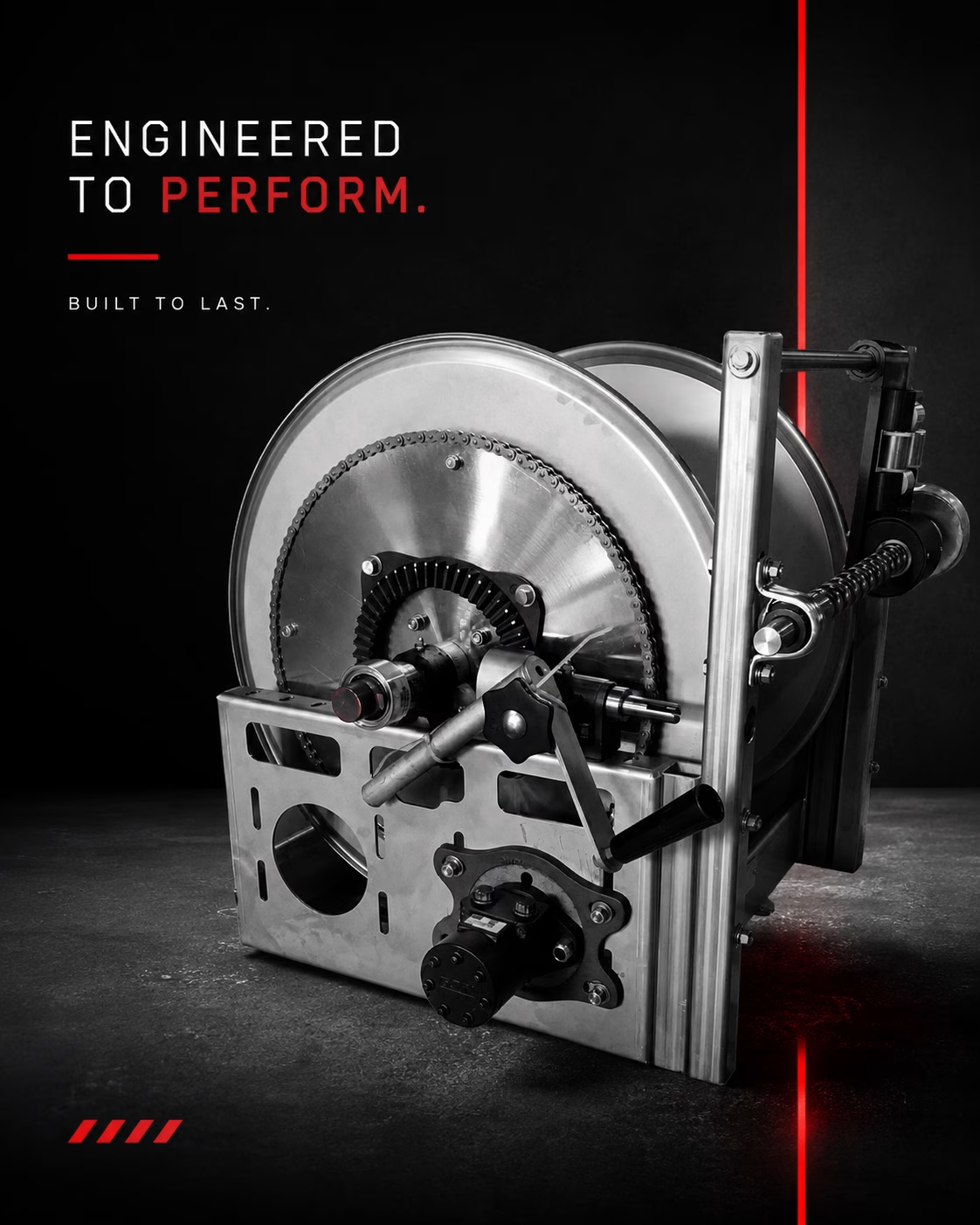
At UHR, our aluminum cast fluid-path reel range includes configurations for applications such as fuel delivery and aviation servicing.
The appropriate design depends on the required flow, fluid compatibility, pressure, and connection requirements.
Fabricated Fluid Path Hose Reels
Fabricated fluid-path reels use manufactured and assembled components to create the required fluid-routing configuration.
Fabrication can provide flexibility when an application calls for specialized dimensions, connections, or arrangements.
This makes fabricated designs particularly relevant for custom industrial equipment.
At Unique Hose Reels, custom fabrication capabilities allow us to develop hose reel configurations around application-specific requirements rather than limiting every customer to a standard design.
Single-Wrap Hose Reels
Single-wrap hose reels store the hose in a single layer around the drum rather than allowing it to wind in multiple layers.
This configuration may be beneficial where organized hose storage and a controlled winding arrangement are important.
UHR’s R21000 Series includes single-wrap designs for petroleum and aviation applications.
The correct drum dimensions and capacity depend on the actual hose specifications.
Where Are Industrial Hose Reels Used?
Industrial hose reels serve a wide range of industries, but the operating requirements can vary considerably.
Fuel Delivery and Petroleum Handling
Fuel delivery operations require reliable hose management for transferring petroleum products between equipment, vehicles, and storage systems.
Important considerations include:
- Product compatibility
- Fluid-path construction
- Hose dimensions
- Mounting location
- Rewind method
- Grounding and bonding requirements
- Operating environment
Custom reels can be configured to suit specialized tanker installations and fluid-transfer requirements.
Aviation Servicing
Aviation applications require careful attention to hose handling, fluid compatibility, cleanliness, and applicable fueling procedures.
Reel selection can involve:
- Larger hose diameters
- Specific fluid-path connections
- Single-wrap or other specialized drum arrangements
- Powered rewind
- Vehicle-mounted installations
Aviation hose reel configurations must be evaluated against the requirements of the fueling operation.
Fire and Rescue
Fire and rescue operations demand equipment suited to the required hose, working pressure, environment, and deployment method.
Industrial hose reels may be configured for vehicle mounting, water delivery, and specialized service requirements.
Hose capacity, accessible mounting, and reliable operation are important considerations.
Sewer Jetting and Industrial Cleaning
High-pressure industrial cleaning applications place unique demands on hose reel systems.
These applications may require:
- Specialized high-pressure fluid paths
- Heavy-duty structural construction
- Custom hose capacity
- Powered rewind
- Specialized fittings and connections
UHR manufactures custom fabricated dual-fluid-path jetter hose reels, with application-specific configurations designed for pressures up to 40,000 PSI.
Such pressure ratings apply to specifically engineered configurations and should never be assumed to apply to every reel or component.
Industrial Manufacturing and Maintenance
Manufacturing facilities use hose reels for water, air, lubricants, and other industrial services.
The appropriate reel depends on the fluid, operating conditions, frequency of use, and facility layout.
Proper hose management can help keep working areas organized and reduce the need for hoses to remain loose across operating spaces.
When Does a Standard Hose Reel Become a Custom Hose Reel?
Standard hose reels are designed around predefined configurations.
For many applications, they provide a suitable solution.
But industrial operations frequently involve requirements that fall outside standard product specifications.
A custom hose reel may be the right approach when you need:
- Unusual hose diameters or lengths
- Specialized pressure requirements
- Non-standard mounting arrangements
- Limited installation space
- Unique inlet or outlet connections
- Specialized materials
- A particular rewind system
- Multiple fluid paths
- Integration with existing machinery or vehicles
Custom manufacturing allows those requirements to influence the design from the beginning.
Why Manufacturer Experience Matters
Designing an industrial hose reel involves more than making a drum large enough to hold a hose.
The reel must account for the hose’s physical characteristics, fluid-path requirements, mounting loads, drive system, and operating environment.
A properly engineered design also considers maintenance access, safe operation, and how the reel integrates with surrounding equipment.
Since 2006, Unique Welding & Fabricating has provided industrial hose reel solutions through its manufacturing capabilities in Ontario, Canada.
Our capabilities include engineering, CAD design, machining, welding, and custom fabrication.
That manufacturing foundation allows us to work with customers whose applications demand more than an off-the-shelf product.
How Do You Choose the Right Hose Reel Design?
Although the different types of reels have specific advantages, the final choice should always be based on the application.
Start by determining:
- Hose requirements: Diameter, length, weight, and minimum bend radius.
- Operating conditions: Fluid type, pressure, and temperature.
- Rewind requirements: Manual, spring, electric, hydraulic, or pneumatic.
- Installation requirements: Available space, mounting, and hose routing.
- Environmental conditions: Corrosion, outdoor exposure, and operating demands.
- Connection requirements: Inlet, outlet, swivel, and other fittings.
Once these specifications are established, the appropriate reel design can be evaluated.
For a more detailed specification checklist, see our guide on How to Choose the Right Industrial Hose Reel for Your Application.
Frequently Asked Questions About Industrial Hose Reels
What are the main types of industrial hose reels?
The five main types, categorized by rewind mechanism, are hand crank, spring rewind, electric, hydraulic, and air-operated hose reels. Each uses a different method of deploying or retrieving the hose and is suited to different operating requirements.
What is the difference between an electric and hydraulic hose reel?
Electric hose reels use an electric motor, while hydraulic hose reels use hydraulic power. The better option depends on the available power source, required torque, duty cycle, and operating environment.
What is the best hose reel for heavy-duty industrial use?
There is no universal best design. Heavy-duty applications may benefit from powered rewind, robust construction, and application-specific fluid-path components. The appropriate selection depends on hose weight, length, pressure, and usage frequency.
What is a fabricated fluid-path hose reel?
A fabricated fluid-path hose reel uses manufactured and assembled components to form the reel’s fluid-routing system. Fabricated configurations can offer flexibility for applications requiring specialized connections, dimensions, or designs.
What is a single-wrap hose reel?
A single-wrap reel stores the hose in one layer around the drum. This arrangement provides a controlled winding configuration and is used in selected petroleum, aviation, and other industrial applications.
Can industrial hose reels be customized?
Yes. Custom hose reels can be manufactured around specific hose dimensions, fluid-path requirements, mounting arrangements, operating pressures, materials, and rewind systems.
Can industrial hose reels handle high-pressure applications?
Yes, when specifically engineered and rated for the required pressure. The complete fluid path, including hoses, swivels, connections, and related components, must be suitable for the application.
Built for the Application. Designed for the Job.
Industrial hose reels may share a common purpose, but their designs can differ considerably.
A hand crank reel can be the right solution for simple manual operation. A spring rewind reel may be more convenient for frequent deployment. Electric, hydraulic, and air-powered reels can provide the powered retrieval needed for more demanding operations.
Beyond the rewind mechanism, the materials, fluid path, hose capacity, and mounting arrangement all influence the final design.
At Unique Hose Reels, we believe the right equipment starts with understanding the application.
Whether you need a standard industrial hose reel or a fully customized configuration, our manufacturing capabilities allow us to develop solutions that fit the job.
Looking for an industrial hose reel designed around your requirements?
Explore our industrial hose reel range or contact Unique Hose Reels to discuss your application.
Unique Hose Reels | Custom Industrial Hose Reel Manufacturing | Mississauga, Ontario, Canada