
Ever wondered what really makes a hose reel heavy-duty? Today, we’re breaking down the key differences and why they matter.
A hose reel used occasionally in a maintenance facility operates under very different conditions than one mounted on a fuel delivery tanker, exposed to harsh weather, or handling high-pressure fluid in an industrial environment.
While both standard and heavy-duty hose reels serve the same basic purpose, their construction, capabilities, and intended operating conditions can be very different.
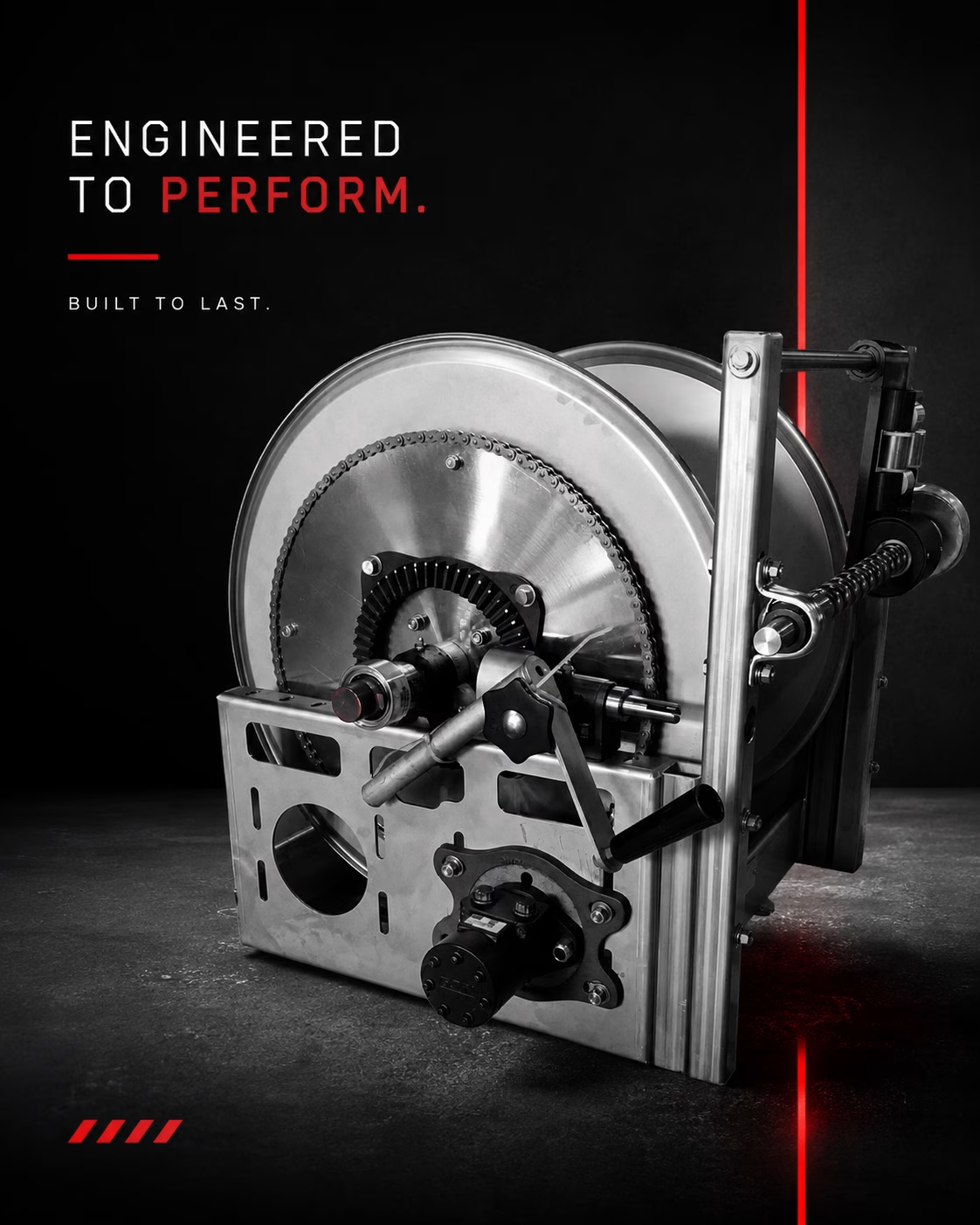
A heavy-duty industrial hose reel is designed to handle more demanding operating conditions through application-specific construction, materials, components, and engineering.
The difference isn’t simply the size or weight of the reel. It’s how effectively the entire system is designed to manage the hose, fluid, pressure, environment, and workload.
At Unique Hose Reels (UHR), we manufacture industrial hose reels for a wide range of applications, including custom configurations designed around specific operating requirements.
Understanding what makes a hose reel heavy-duty can help you select equipment that delivers dependable performance without unnecessary compromises.
What Is a Heavy-Duty Industrial Hose Reel?
A heavy-duty hose reel is designed for applications involving increased mechanical loads, demanding operating environments, frequent use, larger hoses, specialized fluids, or other challenging requirements.
Compared with a standard reel, a heavy-duty configuration may include:
- Reinforced steel or stainless steel construction
- Larger or heavier-duty drums and frames
- Components suited to frequent operation
- Application-specific fluid paths
- Specialized swivel assemblies and connections
- Electric, hydraulic, or pneumatic rewind systems
- Custom mounting and installation configurations
- Materials selected for the operating environment
However, “heavy-duty” is not a universal pressure rating or standardized performance classification.
A reel described as heavy-duty still needs to be evaluated against its actual specifications.
The right design depends on the application—not simply the label.
1. Construction: More Than Just Thicker Steel
One of the most noticeable differences between standard and heavy-duty hose reels is their structural construction.
Industrial hose reels can experience significant mechanical loads during hose deployment, retrieval, transportation, and operation.
The frame, drum, shaft, bearings, and mounting arrangement must be designed to withstand those loads.
A heavy-duty reel may incorporate:
- Robust frame assemblies
- Reinforced mounting structures
- Heavy-gauge steel components
- Engineered drum assemblies
- Appropriately sized shafts and bearings
- Welded or fabricated components designed for the expected loads
For vehicle-mounted applications, the design may also need to account for vibration, movement, and forces encountered during transportation.
Why it matters: A properly engineered structure supports consistent operation and helps reduce the likelihood of deformation, misalignment, and premature mechanical wear.
At UHR, our welding, machining, and fabrication capabilities allow us to develop reel assemblies around the structural requirements of each application.
2. Materials: Choosing the Right Construction for the Environment
The material used to manufacture a hose reel can have a significant impact on its suitability for a particular environment.
Standard equipment may use materials selected for general-purpose service, while specialized industrial applications can require different materials or protective finishes.
Carbon Steel Hose Reels
Carbon steel is commonly used in industrial hose reel construction because of its strength, versatility, and suitability for fabricated components.
It can be an effective choice for a variety of industrial applications when paired with appropriate surface protection.
Stainless Steel Hose Reels
Stainless steel may be preferred when the operating environment requires increased corrosion resistance.
Applications involving regular moisture exposure, washdown procedures, or certain chemical environments may benefit from stainless steel construction.
However, material grade and compatibility still need to be evaluated for the specific application.
Aluminum Components
Aluminum can provide advantages in applications where component weight and corrosion resistance are important.
Cast aluminum fluid-path components are one example of how material selection can influence reel construction.
The key consideration is not which material is universally strongest or best, but which material is appropriate for the operating conditions.
3. Fluid-Path Engineering: What’s Inside Matters
A hose reel is more than a drum that holds hose.
For fluid-transfer applications, the internal fluid path is a critical part of the system.
The fluid path allows product to move through the reel assembly and into the hose, often while the drum rotates.
This makes components such as the swivel joint, inlet, outlet, seals, and associated connections important engineering considerations.
Cast Aluminum Fluid Paths
Cast aluminum fluid-path designs can offer a practical solution for applications where their construction, dimensions, and material properties meet the operating requirements.
Fabricated Fluid Paths
Fabricated fluid paths allow components to be manufactured and assembled around application-specific requirements.
This can provide flexibility for specialized connection arrangements, fluid-path sizes, and custom reel designs.
At Unique Hose Reels, we manufacture both cast aluminum and fabricated fluid-path hose reel configurations.
Our custom manufacturing capabilities allow fluid-path designs to be evaluated alongside hose size, operating pressure, fluid compatibility, and installation requirements.
Why Fluid-Path Design Matters
A fluid path must be suitable for the required:
- Operating pressure
- Flow requirements
- Fluid compatibility
- Temperature
- Connection sizes
- Swivel operation
- Sealing requirements
An incorrectly specified fluid path can affect performance, create compatibility problems, or introduce safety risks.
The reel’s pressure capability must be established using the ratings of the complete fluid-path assembly, not just the hose or one component.
4. Pressure Ratings: Heavy-Duty Doesn’t Automatically Mean High-Pressure
One common misconception is that every heavy-duty hose reel is designed for high-pressure use.
That isn’t necessarily the case.
A reel designed to handle a large, heavy hose at relatively low pressure may require substantial structural strength without needing a high-pressure fluid path.
Conversely, a compact hose reel may require specialized high-pressure components even though the hose itself is relatively small.
Structural load capacity and fluid pressure rating are two different engineering considerations.
For high-pressure applications, the complete system needs to be evaluated.
This includes:
- Hose pressure rating
- Swivel and fluid-path pressure rating
- Inlet and outlet connections
- Seals and fittings
- Operating temperature
- Expected pressure fluctuations
- Applicable safety requirements
High-Pressure Sewer Jetter Applications
High-pressure sewer jetting is an example of where specialized hose reel construction becomes especially important.
UHR manufactures custom fabricated sewer jetter hose reels, including dual-fluid-path configurations designed for applications requiring pressures up to 40,000 PSI.
These are specialized configurations engineered for particular operating conditions, not general pressure ratings for all UHR hose reels.
High-pressure equipment must always be specified and operated within the ratings and requirements of its individual components.
5. Hose Capacity: Larger Hoses Require Different Engineering
Hose capacity is another important difference between standard and heavy-duty hose reels.
The amount of hose a reel can accommodate depends on more than its overall dimensions.
Important considerations include:
- Hose inside diameter
- Hose outside diameter
- Total hose length
- Hose weight
- Minimum bend radius
- Drum diameter and width
- Winding arrangement
Larger or heavier hoses increase the mechanical demands placed on the reel.
For example, the total weight of a fully loaded reel can affect the shaft, bearings, frame, mounting structure, and drive system.
A properly designed reel must accommodate these loads while allowing practical hose deployment and retrieval.
This is particularly important for tanker trucks, aviation equipment, and other installations where mounting space may be limited.
6. Rewind Systems: Choosing the Right Power for the Workload
Both standard and heavy-duty hose reels can use manual or powered rewind mechanisms.
The difference comes down to selecting components appropriate for the expected hose weight, operating frequency, and retrieval requirements.
Hand Crank Reels
Hand crank reels provide straightforward manual operation and may be suitable for heavy-duty applications where operator-controlled retrieval is practical.
Spring Rewind Reels
Spring rewind systems provide automatic hose retrieval using stored mechanical energy.
Spring capacity and the operating arrangement must be appropriate for the hose and expected service conditions.
Electric Hose Reels
Electric rewind systems use a motor to assist with hose retrieval.
They can be useful where hoses are longer, heavier, or frequently deployed.
Hydraulic Hose Reels
Hydraulic rewind systems are commonly considered for equipment requiring powered retrieval where hydraulic power is available.
They can be configured for demanding applications that require substantial retrieval torque.
Air-Operated Hose Reels
Air-operated systems use compressed air to power hose retrieval and may be suitable where an appropriate pneumatic supply is available.
The right rewind system is the one properly matched to the hose, workload, power supply, and operating environment.
7. Durability: Designed Around Real-World Operating Conditions
A hose reel may perform well in a controlled environment but experience different demands when installed on a vehicle or exposed to industrial conditions.
Heavy-duty equipment should be evaluated against its intended operating environment.
Consider:
- Vibration during transportation
- Exposure to rain, snow, and moisture
- Corrosive environments
- Frequent hose deployment
- Mechanical wear
- Temperature changes
- Outdoor storage
- Maintenance accessibility
These conditions can affect the choice of materials, bearings, seals, mounting arrangements, protective finishes, and other components.
Durability is not simply about adding more material.
It is about selecting the right design and components for the expected conditions.
8. Custom Manufacturing: When Standard Isn’t Enough
One of the biggest advantages of working directly with a hose reel manufacturer is the ability to develop equipment around specific operational requirements.
A standard reel may be perfectly suitable for many applications.
However, specialized industrial operations often present challenges that standard configurations cannot accommodate.
Examples include:
- Restricted mounting space
- Unusual hose dimensions
- Specialized fluid-path requirements
- High operating pressures
- Non-standard connections
- Heavy hose loads
- Unique mounting positions
- Multiple fluid paths
- Custom rewind configurations
- Specialized materials
Custom manufacturing allows these requirements to be considered during the design process.
How UHR Approaches Custom Hose Reel Manufacturing
At Unique Hose Reels and Unique Welding & Fabricating, our manufacturing capabilities support the development of specialized hose reel solutions.
Our capabilities include:
Engineering and CAD Design
Developing configurations around the customer’s application, dimensional constraints, and operating requirements.
CNC Machining
Manufacturing precision components where custom dimensions or connections are required.
Welding and Fabrication
Building reel structures and assemblies suited to the application.
Fluid-Path Configuration
Developing cast aluminum or fabricated fluid-path arrangements according to the required specifications.
Custom Assembly
Integrating appropriate rewind mechanisms, mounting arrangements, and other components into the final configuration.
The objective is straightforward: develop equipment that fits the application instead of forcing the application to fit a standard reel.
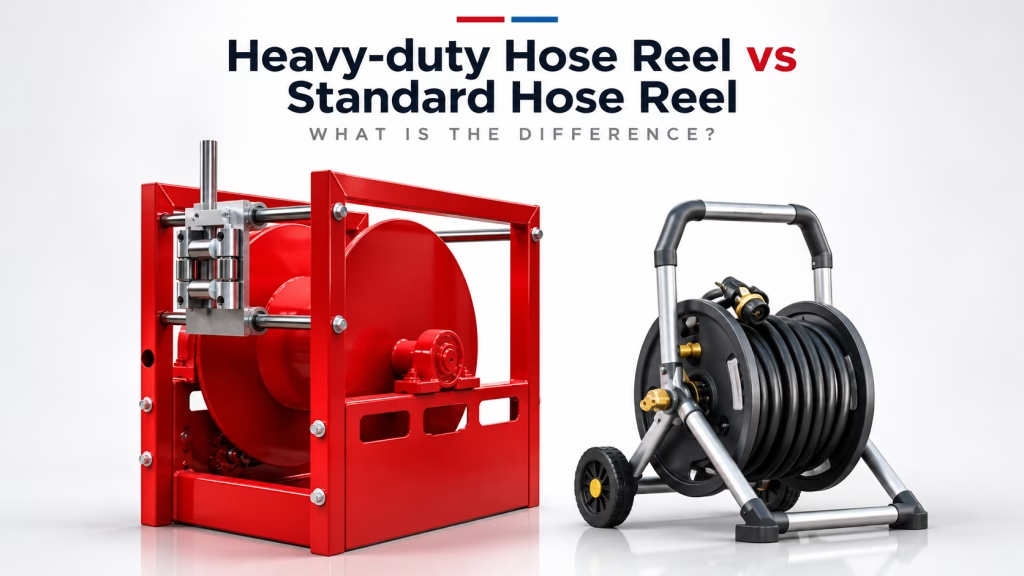
Heavy-Duty vs. Standard Hose Reels: Key Differences
| Feature | Standard Hose Reel | Heavy-Duty Hose Reel |
|---|---|---|
| Construction | General-purpose design | May use reinforced or specialized construction |
| Hose Capacity | Typically standard capacities | May accommodate larger, longer, or heavier hoses |
| Materials | Common material configurations | Materials chosen for demanding conditions |
| Fluid Path | Standard available configurations | May require specialized fluid-path design |
| Rewind System | Manual, spring, or powered | Manual or powered, matched to demanding loads |
| Mounting | Common mounting arrangements | May require reinforced or custom mounting |
| Operating Environment | General service | Demanding industrial or mobile applications |
| Customization | Often limited by product range | Greater potential for application-specific design |
These are general distinctions rather than universal product specifications. Individual standard and heavy-duty models can overlap in many features.
When Should You Invest in a Heavy-Duty Hose Reel?
A heavy-duty reel may be worth considering when the application involves:
- Large or heavy industrial hoses
- Frequent hose deployment and retrieval
- Vehicle-mounted operations
- Demanding environments
- High mechanical loads
- Specialized fluid transfer
- High-pressure service
- Non-standard mounting or connections
However, selecting a heavy-duty reel does not necessarily mean choosing the largest or most expensive option.
An appropriately engineered standard reel may be the best solution for a less demanding application.
The goal should always be to match the equipment to the job.
Frequently Asked Questions
What is considered a heavy-duty hose reel?
A heavy-duty hose reel is designed for demanding operating conditions involving substantial mechanical loads, larger hoses, frequent use, harsh environments, or specialized fluid-handling requirements. The term does not represent one universal pressure or performance rating.
Are heavy-duty hose reels always made from steel?
No. Heavy-duty hose reels may use carbon steel, stainless steel, aluminum, or combinations of materials depending on the application and required performance characteristics.
Can a heavy-duty hose reel handle high pressure?
Yes, when specifically designed and rated for the intended pressure. A heavy-duty structural design alone does not establish the reel’s fluid-pressure rating.
What is the difference between cast and fabricated fluid paths?
Cast fluid paths use cast components, while fabricated fluid paths use manufactured and assembled components. Both can be suitable for industrial applications depending on pressure, fluid, connection requirements, and design.
Are hydraulic hose reels better than electric hose reels?
Neither system is universally better. Hydraulic rewind may be appropriate where hydraulic power is available or high retrieval torque is required, while electric rewind may be suitable where electrical power is more practical.
When should I choose a custom heavy-duty hose reel?
Custom manufacturing is worth considering when standard reels cannot adequately accommodate hose size, pressure, mounting space, fluid compatibility, connections, or other application-specific requirements.
How can I determine whether a hose reel is suitable for my application?
Review the hose specifications, operating pressure, temperature, fluid, mounting requirements, usage frequency, operating environment, and applicable component ratings. A manufacturer can use this information to help determine the appropriate reel configuration.
Built for the Application. Engineered for the Demands.
The difference between a standard hose reel and a heavy-duty industrial reel goes well beyond size or appearance.
Construction, materials, fluid-path design, operating pressure, hose capacity, rewind systems, and the working environment all contribute to the final design.
For many applications, a standard reel may provide everything required.
For more specialized or demanding operations, heavy-duty construction and custom engineering can help deliver a better-matched solution.
At Unique Hose Reels, we understand that no two industrial operations are exactly alike.
With manufacturing capabilities built around engineering, machining, welding, and custom fabrication, we develop hose reel solutions tailored to the demands of the application.
Whether you require a standard industrial reel or a specialized heavy-duty configuration, our focus remains the same: manufacturing equipment designed around real-world requirements.
Built for the job. Engineered for the application. Manufactured to perform.
Need a heavy-duty hose reel for your operation?
Contact Unique Hose Reels to discuss your hose specifications, mounting requirements, operating conditions, and custom manufacturing options.
Unique Hose Reels | Industrial Hose Reels & Custom Manufacturing | Ontario, Canada