
Industrial operations often depend on equipment that doesn’t get much attention until something goes wrong.
A hose needs to be stored, deployed and retrieved. Multiple tank compartments need to be unloaded efficiently. Fluids need to be directed, isolated and controlled. Connections need to match the application. Equipment needs to fit the available space and perform reliably under demanding operating conditions.
That is where industrial fluid handling equipment comes in.
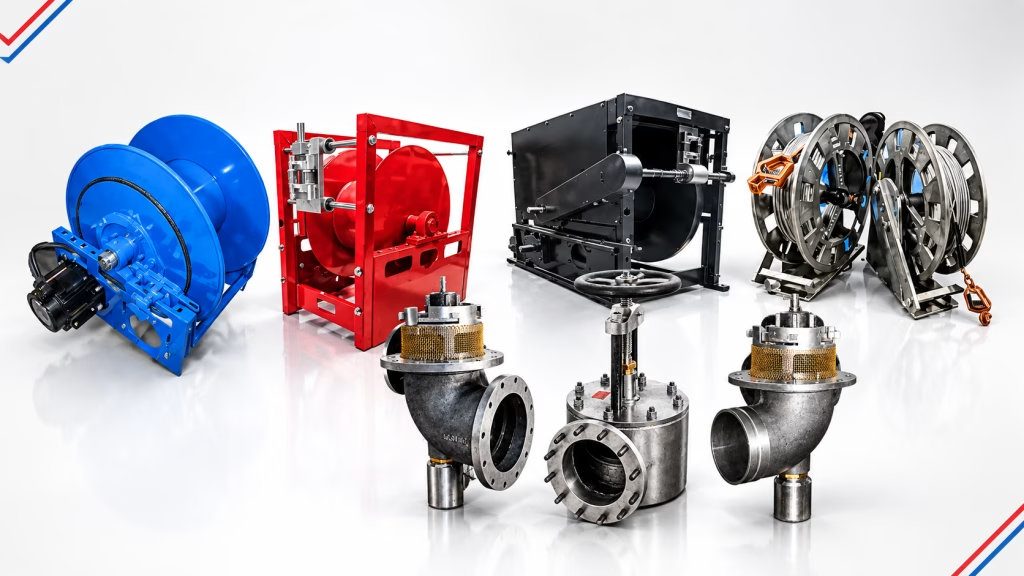
Industrial fluid handling equipment includes the components used to store, transfer, direct, control and manage liquids and other fluids throughout an industrial system. Common examples include hose reels, tank manifold systems, industrial valves, piping components and specialized connections.
For many applications, these components do not operate independently. A hose reel may handle the hose used for fluid transfer, a manifold may control how product moves from multiple compartments, and valves may regulate or shut off the flow.
Understanding how these components work together is an important first step when specifying equipment for fuel delivery, tanker operations, industrial maintenance, aviation, fire and rescue, sewer jetting and other demanding applications.
What Are the Main Components of an Industrial Fluid Handling System?
Although every application is different, three important components found across many fluid-handling systems are hose reels, manifolds and valves.
Each performs a different function.
1. Industrial Hose Reels
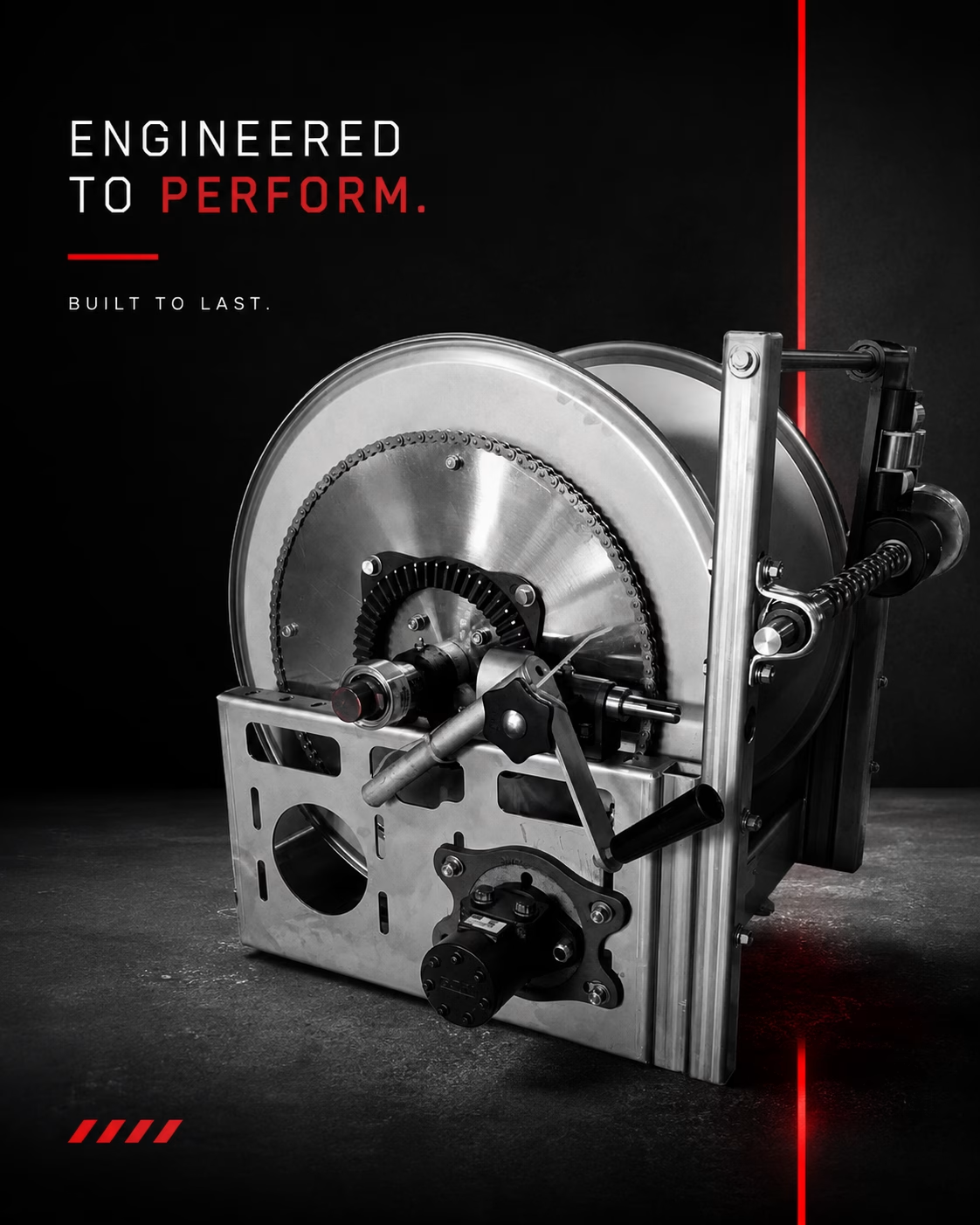
An industrial hose reel is designed to store, organize and deploy a hose while providing a controlled method of handling the hose during operation.
Hose reels can be designed for many different applications and can use different rewind mechanisms, including:
- Hand crank
- Spring rewind
- Air rewind
- Hydraulic rewind
- Electric rewind
The appropriate configuration depends on factors such as hose size, hose length, pressure, fluid, operating environment, available mounting space and how frequently the reel will be used.
For some applications, a standard reel may be suitable. For others, a custom-designed reel may be the better solution.
Custom hose reels can be engineered around specific hose dimensions, mounting requirements, fluid paths, operating conditions and customer requirements.
2. Tank Manifold Systems
A tank manifold system is used to control and direct product from multiple compartments or outlets, particularly in tanker and fuel delivery applications.
Instead of requiring operators to connect and disconnect multiple individual components during unloading, a properly designed manifold system can provide a more organized method of managing product flow.
Tank manifold systems can be configured as single-bank or dual-bank systems and may use mechanical or air-operated controls.
The right configuration depends on the tanker design, number of compartments, products being transported and the way the system needs to be operated.
For applications involving multiple products, manifold design becomes particularly important because the system must provide controlled product routing while helping operators manage the correct connections and flow paths.
3. Industrial Valves
Industrial valves control, direct or stop the movement of fluid through a system.
Depending on the application, valves may be manually, pneumatically or hydraulically operated.
Industrial valve selection can involve several considerations, including:
- Fluid type
- Pressure
- Temperature
- Flow requirements
- Valve size
- Connection type
- Operating method
- Installation location
- Required shutoff characteristics
For tanker and industrial applications, specialized valves may be designed for specific operating conditions.
For example, emergency valves can provide controlled shutoff capabilities, while specialized rear-head or hot-head valves can be used for applications involving hot, cold or viscous materials.
How Do Hose Reels, Tank Manifolds and Valves Work Together?
The easiest way to understand these components is to look at the job they perform within the overall fluid-handling process.
The hose provides the pathway.
The reel manages the hose.
The manifold manages multiple fluid pathways or compartments.
The valve controls the flow.
Consider a tanker unloading application.
A tanker may contain multiple compartments carrying different products. A manifold system can provide controlled access to those compartments. Valves can control or isolate the individual flow paths. A hose reel can provide an organized method of storing and deploying the transfer hose.
The individual components therefore become part of a larger system.
This is an important consideration when selecting equipment because the best individual component is not necessarily the best solution if it does not integrate properly with the rest of the system.
Why Customization Matters in Industrial Fluid Handling
Industrial equipment is rarely used in a perfectly standardized environment.
Mounting locations vary.
Available space varies.
Hose lengths vary.
Fluid requirements vary.
Pressure and temperature requirements vary.
Operating procedures vary.
That is one reason custom manufacturing can be important for industrial fluid handling applications.
A custom hose reel, manifold or valve configuration can be developed around the actual requirements of the application rather than forcing the application to fit a standard product.
At Unique Hose Reels and Unique Welding & Fabricating, custom manufacturing is an important part of the approach to industrial equipment.
The design process can consider the customer’s specific application, including the required hose, fluid, pressure, operating environment, mounting arrangement and method of operation.
Engineering, CAD, machining, welding and fabrication capabilities can then be incorporated into the manufacturing process as required.
The result is equipment designed around the job it needs to perform.
What Should You Consider When Selecting Fluid Handling Equipment?
There is no single specification that determines whether a hose reel, manifold or valve is appropriate.
A proper selection process starts with the application.
1. What Fluid Is Being Handled?
The fluid being transferred can influence material selection, seals, hose compatibility, valve configuration and other components.
Fuel, water, oil, petroleum products, viscous materials and other fluids can have very different handling requirements.
2. What Pressure Is Required?
Pressure is one of the most important operating specifications.
The equipment must be appropriate for the required operating conditions, including the hose, reel, valves, connections and other components within the system.
High-pressure applications may require significantly different equipment than standard fluid transfer applications.
3. What Temperature Will the Equipment Experience?
Temperature can affect hoses, seals, materials and valve performance.
Applications involving hot products or extreme temperature ranges should therefore be evaluated before equipment is specified.
4. How Will the Equipment Be Operated?
Consider whether the equipment will be:
- Manually operated
- Electrically operated
- Hydraulically operated
- Pneumatically operated
The operating method can have a significant effect on the final design.
5. Where Will the Equipment Be Installed?
Available space and mounting location should be considered early in the design process.
A reel that works well in one installation may not fit another.
Mounting position, hose routing, access for maintenance and operator accessibility can all affect the design.
6. How Frequently Will the Equipment Be Used?
An occasional-use application and a high-cycle industrial operation may have very different equipment requirements.
Frequency of use, duty cycle and operating environment should be considered when selecting the appropriate equipment.
7. Does the Application Require Multiple Fluid Paths?
Applications involving multiple products or tanker compartments may require additional consideration.
Tank manifold configuration, valve arrangement and fluid routing should be designed around how the equipment will actually be operated.
When Should You Consider Custom Industrial Equipment?
Custom equipment is worth considering when an off-the-shelf product does not adequately address the application.
Examples include:
- Limited installation space
- Unusual mounting requirements
- Specialized hose dimensions
- High-pressure applications
- Multiple fluid paths
- Specialized materials
- Unique connection requirements
- Unusual operating environments
- Specialized rewind requirements
- Integration with existing equipment
Customization does not necessarily mean completely reinventing a product.
Sometimes a relatively small change in mounting, connections, materials, dimensions or operation can make the difference between a standard product and a solution that works properly for the application.
The Manufacturer Matters
Industrial fluid handling equipment should not be viewed only as a catalog purchase.
The manufacturer needs to understand the application.
A manufacturer with engineering and fabrication capabilities can evaluate the requirements and determine how the equipment should be configured, manufactured and integrated.
At Unique Welding & Fabricating, custom fabrication capabilities include engineering, CAD, welding, machining and CNC-related manufacturing capabilities.
That experience allows hose reels, manifolds, valves and related components to be approached as engineered industrial equipment rather than simply off-the-shelf components.
For customers with specialized requirements, this can be especially valuable.
A Practical Approach to Specifying Industrial Fluid Handling Equipment
Before requesting a quote or selecting equipment, gather as much application information as possible.
A useful starting checklist includes:
Application
- What will the equipment be used for?
Fluid
- What product or fluid will be handled?
Pressure
- What is the required operating pressure?
Temperature
- What operating temperature range is expected?
Hose
- What hose size and length are required?
Mounting
- Where will the equipment be installed?
Operation
- Manual, electric, hydraulic or pneumatic?
Connections
- What connection type and size are required?
Environment
- Indoor, outdoor, mobile, corrosive or specialized environment?
Customization
- Are there space, mounting, routing or operational requirements that a standard product cannot accommodate?
The more accurately these requirements are defined, the easier it becomes to design equipment that fits the actual application.
Frequently Asked Questions
What is industrial fluid handling equipment?
Industrial fluid handling equipment consists of components used to store, transfer, direct, control or manage fluids in industrial applications. Examples include hose reels, tank manifolds, valves, piping components and specialized connections.
What is an industrial hose reel used for?
An industrial hose reel is used to store, organize, deploy and retrieve hose during fluid transfer or other industrial operations. Reels can be manually or automatically operated depending on the application.
What is a tank manifold?
A tank manifold is a system used to manage and direct product flow from multiple tanker compartments or fluid pathways. Tank manifolds can be configured as single-bank or dual-bank systems and can use mechanical or air-operated controls.
What does an industrial valve do?
An industrial valve controls, directs, regulates or stops fluid flow within a system. Different valve configurations are selected based on the fluid, pressure, temperature, flow requirements and operating method.
When should I choose a custom hose reel?
A custom hose reel should be considered when standard equipment does not meet the application’s hose size, mounting, pressure, fluid, space, operating or connection requirements.
Can hose reels, manifolds and valves be customized?
Yes. Industrial fluid handling equipment can be configured around application-specific requirements. Customization can include dimensions, materials, connections, mounting arrangements, operating methods and other design considerations.
How do I choose the right industrial fluid handling equipment?
Start with the application and define the fluid, pressure, temperature, hose requirements, operating method, installation environment, connections and available space. These requirements can then be used to determine the appropriate hose reel, manifold, valve and related components.
Building a Better Fluid Handling System
The best industrial fluid handling solution is not necessarily the product with the longest list of features.
It is the equipment that is properly matched to the application.
A hose reel needs to handle the hose.
A manifold needs to manage the required fluid paths.
A valve needs to provide the required control.
And all of the components need to work together as part of the overall system.
That is where engineering and manufacturing experience become important.
At Unique Hose Reels and Unique Welding & Fabricating, the focus is on developing practical industrial solutions around real-world customer requirements—from custom hose reels and tank manifold systems to industrial valves and fabricated equipment.
When the application does not fit a standard product, a custom solution may be the better answer.
The right equipment starts with understanding the job it needs to do.